A dental implant is a titanium screw placed in the jawbone that takes over the role of the missing tooth's root. A crown is fitted onto it later. Treatment runs in stages, and the longest of them involves no procedure at all: it is the time the bone needs to grow around the implant.
1. Consultation and assessment
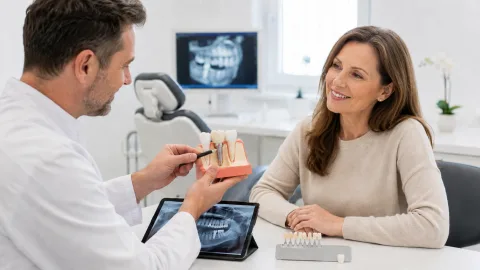
The first stage establishes whether an implant is possible at all. Bone volume, the position of the sinus and of the alveolar nerve, the condition of the gums and of the neighbouring teeth are all checked. A CBCT scan provides the three-dimensional picture required — an ordinary X-ray does not show bone thickness.
2. Digital planning
Using the scan, the implant position is planned on screen: angle, depth and diameter. Planning starts from the shape of the final tooth and works backwards — the implant goes where the crown will need it, not the other way round.
3. Bone grafting, where needed
If bone has resorbed after an extraction, the volume is rebuilt with a graft. Sometimes this is done in the same session as placement; sometimes it has to heal separately for several months. This is the stage that most often lengthens treatment.
4. Placing the implant
The procedure is done under local anaesthetic and takes about an hour for a single implant. The discomfort afterwards is comparable to an extraction and is managed with ordinary medication. The final crown is not fitted at this point.
5. Osseointegration
Then comes healing, usually three to six months, during which bone forms directly on the implant surface. That bond is what allows the implant to withstand chewing forces. It cannot be rushed, and loading too early is a common cause of failure.
A temporary restoration can be worn during this time so the gap is not visible.
6. Abutment and crown
Once integrated, the abutment — the connecting piece — is attached and an impression or scan is taken for the final crown. The crown is made in the laboratory, tried in, adjusted against the bite and fitted.
What keeps an implant long term
- Hygiene. An implant cannot decay, but the tissue around it can become inflamed. Peri-implantitis is the equivalent of gum disease and leads to losing the implant.
- Regular check-ups. They catch inflammation before it reaches the bone.
- Smoking. It measurably lowers success rates, especially in the first months.
- Grinding. Excessive force overloads both the implant and the crown.
This article is general information. Stages and timings vary case by case and are set after clinical and radiographic assessment.