Brushing properly twice a day, with floss, removes most dental plaque. The problem is what stays behind: undisturbed plaque mineralises within 24–72 hours into tartar, and tartar cannot be brushed off.
Plaque and tartar: the difference
Plaque is a soft, sticky film of bacteria and food debris. It forms constantly and can be removed at home.
Tartar is plaque hardened by mineral salts from saliva. It is rough and porous, which makes it an ideal surface for still more plaque. It can only be removed with instruments, in the surgery.
Why it matters for the gums
Tartar builds up mostly at the gum margin and below it. The bacteria there keep the gum permanently inflamed: it reddens, swells and bleeds when brushed. Bleeding is not a sign to brush more gently — it is a sign the area needs cleaning.
Left alone, that inflammation advances towards the bone supporting the tooth. Periodontitis is irreversible: lost bone does not grow back on its own, and teeth start to loosen. In adults it causes as much tooth loss as decay does.
What a professional cleaning involves
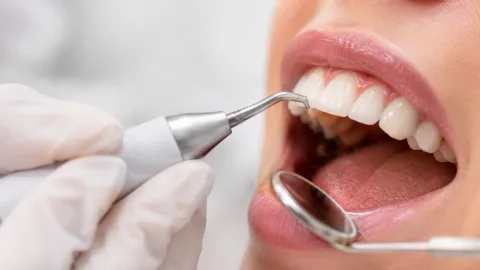
- Ultrasonic scaling. Vibration lifts hard deposits from the tooth surface and from below the gum margin.
- Airflow. A fine jet of air, water and powder removes staining from coffee, tea, wine or smoking, in places a brush cannot reach.
- Professional polishing. A smooth surface holds new plaque less readily.
- The check. The appointment is also an opportunity to catch early decay or a receding gum in time.
It usually takes under an hour. Any sensitivity afterwards is short-lived.
How often
For most adults, every six months. The interval shortens for smokers, for patients in orthodontic treatment, with implants, with diabetes, or with a history of gum disease. Your dentist sets the right rhythm after seeing how quickly tartar builds up in your case.
What to do at home in between
A professional cleaning does not replace the daily routine — it resets the starting point. Two minutes of brushing twice a day, floss or interdental brushes daily, and a new brush head every three months covers most of what is needed.
This article is general information and does not replace a dental examination.