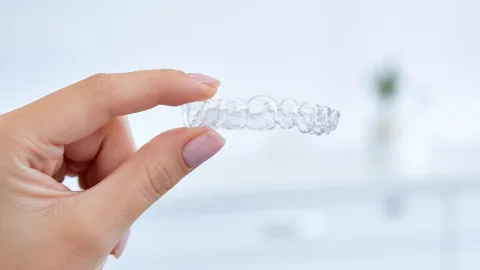
Clear aligners are custom-made trays of medical-grade plastic, changed every one or two weeks. Each set differs only slightly from the one before, and that small difference is what pushes teeth towards the planned position.
How a tooth actually moves
Teeth are not rigidly fixed in bone. The root is attached to its socket by a ligament, and light constant pressure causes bone to resorb on one side and form on the other. The tooth travels through the bone, a fraction of a millimetre at a time.
The principle is identical with fixed braces. Only the way the force is applied differs: through wire and bracket, or through the shape of the tray.
What treatment involves
- Scanning. A digital impression of both arches replaces impression putty.
- Simulation. The movement is planned digitally, stage by stage. You can see the projected end position before starting.
- Attachments. Small tooth-coloured composite bumps are bonded to some teeth so the tray has something to grip for certain movements. They are removed at the end.
- The series of trays. Worn in order, each for a few days or weeks, according to plan.
- Retention. A retainer afterwards is not optional — teeth naturally tend to drift back.
The 22 hours
This is the condition everything else depends on. Trays need 20–22 hours a day, out only for meals and brushing. Aligners worn irregularly do not simply take longer — treatment drifts off the plan, and the next trays stop fitting.
That is the practical difference from fixed braces, which work regardless of the patient's willpower. Aligners trade discipline for comfort and discretion.
Which cases they treat
Aligners handle mild and moderate crowding, spacing, small rotations and relapse after earlier orthodontic work. Complex cases — skeletal discrepancies, impacted teeth, large root movements — often remain an indication for fixed braces or combined treatment.
An orthodontist can say which category a case falls into after examination and radiographs. The claim that "anything can be fixed with aligners" is not realistic.
Hygiene during treatment
The tray covers the tooth, so whatever is left on it stays there for hours. Brushing after every meal and rinsing the tray are not optional. Coloured or hot drinks only with the trays out.
This article is general information and does not replace an orthodontic consultation.